Will AI Replace Teachers in the Classroom

A student can now ask a chatbot to explain fractions, draft an essay outline, translate a paragraph, or quiz them on the War of 1812 before lunch. That raises a fair question for families, educators, and school leaders: if AI can teach parts of a lesson, will it replace the teacher standing in the room?
The short answer is no. AI will change classroom teaching, sometimes in big ways, but it will not replace teachers in the deeper sense of the job. A classroom is not only a place where information moves from one person to another. It is a living space where attention, trust, motivation, safety, feedback, judgment, and relationships shape learning.
AI can support some of that work. It can also create new problems. The real question is not whether schools can stop AI from entering classrooms. It is how teachers, students, and systems can use it wisely without handing over the human parts of education.
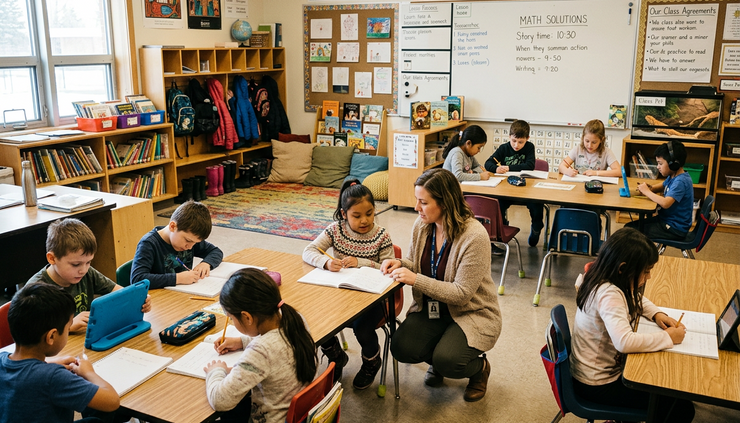
AI can handle some tasks very well
AI is good at pattern-based tasks. That makes it useful in classrooms, especially when teachers need more time and students need more practice.
For example, AI tools can help with:
Generating practice questions at different difficulty levels
Explaining a concept in simpler language
Giving quick feedback on grammar or structure
Translating basic instructions for multilingual learners
Creating reading passages on a given topic
Helping students brainstorm ideas
Supporting lesson planning with draft activities
These uses are practical. A teacher might ask an AI tool to create three versions of a math worksheet, one for students who need review, one for the main lesson, and one for extension. That does not replace the teacher. It saves time on a task that can be slow and repetitive.
AI can also help students who feel stuck. A student who is embarrassed to ask a question in front of the class may feel more comfortable typing, “Explain this like I am in Grade 6.” For some learners, that extra private attempt can make the difference between giving up and trying again.
There is also value in fast feedback. A teacher cannot read 28 drafts at the exact same moment. AI can offer immediate comments on a paragraph, point out unclear sentences, or ask a student to add evidence. Used well, this can make revision feel less like a final judgment and more like a normal part of learning.
Still, speed is not the same as wisdom. A fast answer can be wrong, shallow, biased, or misread the student’s real need. That is where the teacher remains essential.
Teaching is more than delivering information
If teaching were only about giving explanations, AI would be a much bigger threat. But teachers do far more than explain.
A teacher notices the student who says they understand but looks lost. They hear when a class discussion is drifting into confusion. They decide when to slow down, when to push ahead, and when to stop the lesson because something more important is happening in the room.
Good teaching involves judgment in real time.
A teacher might notice that a student’s poor quiz result is not about the concept at all. Maybe the student was absent during the key lesson. Maybe they are anxious. Maybe they can do the work orally but struggle to show it in writing. An AI tool may see a wrong answer. A teacher sees a person.
That difference matters.
Classrooms are also social places. Students learn how to listen, disagree, share materials, wait their turn, apologize, lead, and ask for help. These are not side benefits. They are part of education. AI can simulate conversation, but it cannot create the same shared responsibility that comes from learning with real people in a real room.
Teachers also build culture. They decide what kind of classroom it will be. Is it safe to make mistakes? Are students expected to support one another? Does the group value effort, curiosity, and honesty? Those signals come through countless small moments: a look, a pause, a redirection, a private word after class.
AI can assist with instruction, but it cannot carry the moral and relational weight of a classroom.

AI changes the teacher’s role rather than removing it
The better comparison is not teacher versus AI. It is teacher with AI versus teacher without AI.
When calculators became common, math teachers did not disappear. Their work changed. Students still needed number sense, problem-solving skills, and enough understanding to know whether an answer made sense. The calculator could compute. It could not decide what the problem meant.
AI is different from a calculator because it can produce language, images, summaries, and suggestions. That makes it more powerful and more confusing. It can look smart even when it is wrong. It can sound confident while inventing details. It can complete tasks that teachers used to rely on for evidence of student thinking.
That means teachers need to adjust.
Assignments may need to focus more on process, discussion, reflection, and in-class demonstration. Instead of only asking for a polished essay, a teacher may ask students to show their notes, explain their choices, compare drafts, or defend a claim in conversation. The goal is not to catch students. The goal is to understand what they can actually do.
AI can also become a subject of learning. Students need to know how to use it responsibly. They need to ask better questions, check sources, spot weak reasoning, and understand when a tool should not be used. In that sense, AI literacy may become as basic as learning how to search the web or cite a source.
Teachers will guide that learning. They will set boundaries around when AI is helpful and when it gets in the way.
Some classroom uses may be simple:
A teacher asks students to critique an AI-generated answer.
Students compare their own explanation with one produced by a chatbot.
A class looks for missing evidence in an AI summary.
Learners use AI to generate practice questions, then solve and verify them.
Students reflect on which parts of an assignment came from them and which came from a tool.
These activities keep the student’s thinking at the centre. AI becomes material to examine, not an invisible shortcut.
The risks are real and schools cannot ignore them
AI brings promise, but it also brings serious concerns. Schools should not treat every new tool as harmless just because it is easy to use.
One concern is accuracy. AI systems can produce false or misleading information. In a classroom, that matters. A student learning a new topic may not know enough yet to spot an error. If the tool gives a neat but wrong explanation, the student may trust it.
Another concern is equity. Not every student has the same access to devices, reliable internet, paid tools, or quiet time at home. If teachers build AI use into homework without care, the gap between students can grow. Public education in Canada already works across differences in income, geography, language, ability, and family support. AI can help reduce barriers, but only if access and design are handled carefully.
Privacy also matters. Students should not have to hand personal information to a tool without clear rules. Schools and boards need to think carefully about data, consent, age limits, and the kinds of platforms allowed in class.
Then there is the question of overreliance. If students use AI for every first draft, every idea, and every explanation, they may practise less of the hard thinking that builds skill. Struggle is not always a sign that something is wrong. Often, it is the moment when learning begins.
AI should reduce needless frustration, not remove every productive challenge.
Teachers help make that distinction. A student who is stuck because instructions are unclear needs support. A student who is stuck because the task is hard may need time, encouragement, and a better strategy. AI cannot reliably know the difference on its own.

The best classrooms will keep humans in charge
A healthy future for education does not ban AI from every classroom. It also does not hand the classroom over to software.
The best path is teacher-led use. That means the teacher decides when the tool serves the lesson, when it distracts from the lesson, and when students need to work without it.
For younger students, AI use may be limited and highly guided. They need strong foundations in reading, writing, number sense, attention, and social learning. They also need adults to protect their privacy and help them understand what tools can and cannot do.
For older students, AI can become part of more complex work. They can use it to test arguments, practise languages, plan research questions, or compare explanations. But they still need clear expectations. If AI helps write a paragraph, the student should know how to revise it, check it, and explain it.
Assessment will also need careful thought. Teachers may rely more on:
In-class writing and problem solving
Oral explanations
Portfolios that show growth over time
Conferences between teacher and student
Drafts, revisions, and reflection notes
Group tasks where process is visible
These approaches are not new. AI may simply make them more necessary.
There is also a workload issue. Teachers already carry heavy demands: planning, marking, communication, supervision, reporting, classroom management, and support for diverse learning needs. If AI can reduce routine prep or help create materials faster, it could give teachers more time for the parts of the job only they can do.
That benefit will not happen automatically. Schools need training, time, and clear policies. Teachers should not be expected to figure out every tool alone after hours. They need chances to test tools, share what works, discuss risks, and build common expectations.
AI in education should serve learning, not add another layer of pressure.
Students still need a trusted adult in the room
Think about the moments that shape a student’s school experience. A teacher remembers their interest in hockey or music. A teacher notices they have been quiet all week. A teacher says, “Try again, I know you can do this.” A teacher helps a class repair harm after a conflict. A teacher adapts a lesson because the group is tired, excited, confused, or ready for more.
These moments may not appear in a lesson plan, but they matter.
Students do not only need answers. They need someone who can help them become the kind of person who asks better questions, handles mistakes, listens to others, and keeps going when work feels difficult.
AI can mimic encouragement. It can produce kind sentences. But it does not know a student in the way a teacher can. It does not share a community with the class. It does not carry responsibility for a child’s growth, safety, confidence, and belonging.
This is why the fear behind “Will AI Replace Teachers in the Classroom” needs a more precise answer. AI may replace some tasks teachers do. It may even replace weak versions of instruction that treat students as passive receivers of content. But it will not replace the full role of a teacher in a healthy classroom.
The future teacher may use AI often. They may ask it for examples, translations, quizzes, reading levels, or planning ideas. They may teach students how to challenge it, improve its output, and recognize its limits. The teacher’s role may become more focused on judgment, relationships, and designing learning experiences that make thinking visible.
That is not a smaller role. In many ways, it is a more demanding one.

The real question is what kind of learning we want
AI will keep improving. Some tools will become common in schools. Others will fade. There will be mistakes, overreactions, good experiments, and needed corrections.
The core purpose of education should guide the choices. Schools are not just information delivery systems. They help young people build knowledge, judgment, confidence, skill, care, and responsibility. Any tool that supports those goals deserves thoughtful attention. Any tool that weakens them deserves limits.
Teachers are central because learning is human work. It involves emotion, identity, effort, feedback, trust, and community. AI can assist with pieces of that work, but it cannot become the adult who knows the learners, reads the room, protects the culture, and makes the hard calls.
So, will AI replace teachers in the classroom? Not if schools understand what teachers actually do.
The better future is not a classroom without teachers. It is a classroom where teachers have better tools, students have stronger guidance, and technology stays in its proper place: useful, limited, and always in service of human learning.


